In 1880, my third great uncle Lafayette Howard was living in the Village of Alcona in Alcona County, Michigan, according to the U.S. Census taken that year. He was 21 years old and, like his older brothers before him, was employed as a telegraph operator.
On August 29 of that year, Lafayette boarded the steamship Marine City, which was headed for points south along Lake Huron. The Marine City, a sidewheel steamer known as the “Lady of the Lake,” was a full-service passenger ship but also carried freight. It was one of the ships in the People’s Line, “a profitable shipping line based out of London, England with a Michigan based operating company.”[i]
According to an ad in the August 10, 1880 edition of the Detroit Free Press, the Marine City left Detroit at 8 p.m. every Tuesday, with stops at Port Huron, Sand Beach, Tawas, Oscoda, Harrisville, Alcona, Alpena, Cheboygan, St. Ignace, Mackinac “and intermediate ports.”[ii] Once the ship reached its northernmost location, it turned around and made a return trip to Detroit.
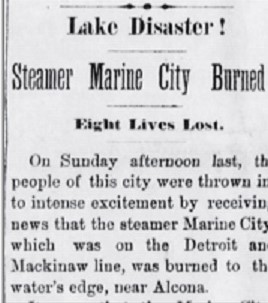
The Marine City was on one such return trip on August 29, 1880 when my great, great, great uncle boarded her. The ship had left the port in Alpena shortly before noon that day, headed for Alcona. Upon arrival in Alcona, passengers and a cargo of shingles were loaded and then the ship started out toward Detroit. Barely fifteen minutes on its way, a fire was discovered in the starboard bunker. Although the crew tried to put out the flames, they were unsuccessful and soon the fire spread to the cabin. [iii]
Most accounts paint a picture of pandemonium aboard the Marine City. The fire rapidly engulfed the ship, and passengers did not have much time before they were forced to jump into the water. Tugboats nearby came to rescue the crew and passengers from the burning ship and rough, cold water. However, a number of people died in the disaster.
The Alpena Argus reported: “Lafayette Howard, of this city, who could not swim, succeeded in crawling onto a plank, where he remained till picked up. He says he saw four persons go down beneath the waters.”[iv]
Ten days after the Marine City tragedy, Lafayette married Frances Hewlett in Elkhart, Indiana.[v] They resided in Alcona, Michigan, suffered the loss of an infant child there, moved to Detroit, Michigan and eventually settled in Portland, Oregon.
[i] Robert L. Bunting, Into Oblivion, (Oxford, Michigan and Downton, England: Black River Trading Company, LTD., 2007), 15. This book is an excellent resource for information on life during the mid-1800s in Northern Michigan as well as a good compilation of accounts of the Marine City disaster.
[ii] Detroit Free Press, August 10, 1880, page 5.
[iii] Alpena Argus, September 1, 1880, page 3.
[iv] Ibid. Lafayette was counted in the 1880 Census as a resident of Alcona (albeit a boarder) yet the Argus considered him to be from Alpena.
[v] Frances was listed as a resident of Alcona Village in the U.S. 1880 Census as well, just a few pages before Lafayette. She was living with her brother-in-law, Frank E. Beard, and sister, Minnie Beard. F.E. Beard was also one of the surviving passengers aboard the Marine City on August 29, 1880.
 tracingthepast