Research Update

It’s been over six months since I’ve posted a family history story.  Unfortunately, I wasn’t coming up with any ideas using the prompts provided by the 52 Ancestors in 52 Weeks challenge (which is not to say it’s not a great project for someone to undertake!).  My lack of inspiration, however, resulted in a dry spell for blog posts.

I didn’t stop researching my family history and making new discoveries during this time period, though.  I continued focusing my research efforts on my great, great, great grandfather, Enoch G. Howard, and his family.  Although I have discovered much about this interesting man’s life, I had never been able to identify who his parents were.  Their names were not given in records I had found for him and no one else researching him seemed to know who they were either. 

I decided to turn to DNA to see if I could find some clues that would point me in the right direction for identifying Enoch’s parents.

I am fortunate that I have a number of relatives who have granted me access to their DNA results on the Ancestry website and other DNA testing sites.  This allows me to analyze all of their “DNA matches.” [1]

In order to determine who Enoch G. Howard’s parents might have been, I used the DNA test results of three of Enoch’s great, great grandchildren. Two of them descend from Enoch’s son George and the third descends from Enoch’s daughter Elizabeth. I began analyzing their shared matches to see if I could find a match who might provide DNA clues extending back over 200 years.[2]

What I discovered after analyzing the three great, great grandchildren’s DNA test results is that they all had a common DNA match, who I’ll refer to as “C.K.”  C.K. had built a small family tree of 16 people on the Ancestry website.  One of the ancestors in her tree was Rozaltha Pearl Howard, born around 1886 in Marine City, Michigan.  When Enoch G. Howard and his wife Henrietta moved to Michigan in 1866, they settled first in Marine City.  The Howard surname and the Marine City connection were indicators to me that C.K.’s genealogy might provide clues about the identity of Enoch G. Howard’s parents and/or siblings.

C.K.’s tree did not extend Rozaltha Pearl Howard’s line back further than Rozaltha herself. My first task, then, was to build out this branch of her tree more. Rozaltha’s father, I found, was James Demarest Howard, born in Michigan in 1861 to James Demarest Howard and Nancy Robertson Howard.  The records I was able to find for James Demarest Howard (Sr.) indicated he was born in 1820, but the reported place of his birth wasn’t consistent – it was either Michigan, New York, or perhaps Vermont.[3]

I could see that other people on Ancestry’s website had been researching this James Demarest Howard family as well.  I examined the family trees they had built and noticed that only one of them – that of Ancestry user Tom K. – named the elder James’ parents: William Morris Howard and Rebecca Demarest.

I began corresponding with Tom K. and learned that Rozaltha Howard was his adoptive grandmother.  He had obtained much of the older Howard family information from his great aunt, Ruby Howard McAlpine, in the 1960s. Tom told me that Ruby had applied for membership in the DAR.  After a bit of research, I found that her application and supporting documents were available to purchase online from the DAR website, which I did. 

Ruby applied for membership based on the lineage of her paternal grandfather, James Demarest Howard (Sr.). Her application states that she was the daughter of James Demarest Howard (Jr.) who was the son of James Demarest Howard (Sr.). It further states that James Demarest Howard (Sr.) was the son of William Morris Howard and Rebecca Demarest Howard.[4]

Supporting documents in the application include a copy of an “old letter and original envelope written by sister of James Demarest Howard.”[5]  The handwritten note, which is undated and has initials at the bottom of the second page which appear to be “SAH”[6], reads in part as follows

                               Howards
grand father  William Morris Howard was born in England (I do not know what town or county in England.) he came to new york, and married Rebekah. Demarest. A Penna Dutch women, for his wife the children were 
James Demarest (born 1820) Father 
Enoch George  (don’t know 
Elizabeth      when born)

The note stated that “grandfather” was killed in New York City when he was thrown off a fire engine. “Father” was thereafter bound out to a man whose surname was VanHorn and moved with Mr. VanHorn to “St Joe, Mich.” The note continued, “Father lost all trace of the family for years; After 30 years Uncle George and Father met.”

What’s in a name?

In the past, I’ve referred to Enoch G. Howard as Enoch Galusha Howard.  That’s what most every family tree on the Ancestry website has as his full name.  I followed suit and used that as his name as well.  However, after reading Ruby Howard McAlpine’s DAR application and seeing the name “Enoch George [Howard],” I went back over all the documentation I had for this name.  Not one record gives his name as Enoch Galusha Howard.  Census records, newspaper articles, city directory listings, probate file – all state his name as Enoch Howard, Enoch G. Howard, or E.G. Howard.  All except one, that is – his Civil War Pension file.  When Enoch applied for Civil War pension benefits, he signed his application “Enoch George Howard.”

With this “new” information, I searched for birth records on Ancestry using the name Enoch George Howard.  There it was, a birth/baptismal record in the New York City United Methodist Church Records for Enoch George Howard, born to William and Rebecca on April 5, 1825, baptized June 12, 1825.[7]

For me, this is good evidence that Enoch G. Howard’s full name was Enoch George Howard and that he was born to William Howard and Rebecca Demarest Howard in 1825 in New York City. (The April 3, 1885 Detroit News article I found about Enoch also correlates with this date and place for his birth: “It was a showery day in April, in 1825, in New York city, that E.G. Howard first put in his appearance…” See my February 17, 2020 post “Favorite Discovery” for the entire article as reprinted in the Alpena Argus.)

Some of Enoch’s descendants may have a hard time giving up the middle name Galusha, however – it has been part of family lore for many, many years.

Next post – what I’ve learned about William Howard.


[1] A “DNA match” is another person who has had his or her DNA tested at the same site as the original tester, and analysis of the two DNA samples reveals they share a sufficient amount of DNA to determine they are related.  Although DNA testing companies estimate relationships between two people who share DNA, they generally cannot tell two people exactly how they are related, except in very close relationships such as parent-child and siblings.

[2]Enoch was born in 1825, so his parents were likely born a generation, or 20-30 years, before that. Analyzing DNA matches to find very distant family connections like this is a slow and tedious process.  I won’t go into too much detail here about how that is done – suffice it to say that you:

  1. look at how much DNA a match shares with the tester whose results you are analyzing to see how closely they might be related;
  2. examine all the other matches the tester and the DNA match have in common to try to determine which line of the family they are related on; and
  3. review any family trees the match might have built on the DNA testing site to see if you can discover the family connection.

If the match you are interested in has put just a limited tree online, you then spend a considerable amount of time building their family tree out further back in the hopes of determining who the common ancestor is.

[3] Although the 1860 and 1870 Census records indicate James D. Howard (Sr.) was born in 1820 in Michigan, the 1880 Census and his death announcement in the Detroit Free Press state he was born in 1820 in New York City.  Three of his children’s death certificates state he was born in New York and one states he was born in Vermont.

[4] Ruby’s eligibility for membership in the DAR was based on Rebecca’s paternal grandfather, James (Jacobus) Demarest, born April 21, 1735 in Schraalenburg, NJ to James Jacobus Demarest and Maria Smith Demarest.

[5] Application of Ruby Annetta Howard McAlpine for DAR Membership dated 27 August 1952.

[6] One of James Demarest Howard (Jr.)’s sisters was named Sophia A. (Anna) Howard.

[7] Ancestry.com. New York, New Jersey and Connecticut, U.S., United Methodist Church Records, 1775-1949 (database online), Vol 139, page 142 (written).
Service

Part of family history research is putting your ancestors into context, which includes looking at what was going on in the world during the time period in which they lived.  Understanding the context of your family members’ lives can give you an idea of what events shaped them and help you to “flesh out” what they may have been like.[i]

As I considered the theme “service,” I thought of how my great, great, great grandfather, Enoch G. Howard, and his oldest son, Lucien, joined the Union Army at the same time in 1861.  Bringing to mind the concept of context, I wondered – what compelled them to join at that particular time? And also – what does the fact of them volunteering to serve tell me about them?

I am far from a Civil War historian, so I dove into the Internet to glean the basics about the beginnings of the War in order to provide context for the time just before Enoch and Lucien joined the Union Army.  From my brief research I learned that – after escalating tensions – shots were fired in April 1861 at Fort Sumter, South Carolina.  After the First Battle of Bull Run/Manassas on July 21, 1961, President Lincoln called for 500,000 more recruits for the Union Army.[ii]

Military records show that in September 1861, Enoch G. Howard mustered into service with Company H of Pennsylvania’s 45th Regiment (Infantry). The men in the company were recruited from Tioga County, Pennsylvania -where Enoch lived – and Enoch entered as a First Lieutenant.[iii]  An article in the April 3, 1885 edition of the Detroit News, sketching a brief overview of Enoch’s life, gave this synopsis of his joining the Union Army: “When war broke out, [he] closed shop, raised a company, and went to the front as lieutenant…”[iv]  So Enoch didn’t simply enlist in the Union Army; he organized a company of volunteers from Tioga County and led them as their First Lieutenant.

At the same time, Enoch’s oldest son Lucien joined the 45th Regiment as a Musician in the Regimental Band.[v]  Records show he mustered in on September 15, 1861.[vi]  According to my current research, he would have been either thirteen or fourteen years old.

Enoch resigned from the 45th Regiment on August 17, 1862.  His Civil War pension application indicates he contracted “chronic rheumatism caused by exposure in wet” while serving with his Company in James Island, South Carolina in June 1862.  The 1885 Detroit News article succinctly sums up the end of this period of Enoch’s service as follows: “home fall ’62 on crutches – all used up with rheumatism – resigned commission in the winter…”

Lucien’s service also came to an end around the same time.  Military records state he was discharged by General Order on September 27, 1862.  Six months later, however, he enlisted with Company K of Pennsylvania’s 11th Cavalry, mustering in as a private at a reported age of 16.[vii]

Enoch, too, chose to serve again, this time enlisting in Company C of the 11th Cavalry (Pennsylvania) on February 17, 1864.  Records indicate he was “promoted to Bugler, September 24, 1864” and mustered out with the Company on August 13, 1865.

As I consider the context of Enoch’s and Lucien’s military service, I can’t help but wonder what in particular motivated them.  Were they responding directly to President Lincoln’s call for more volunteers?  Was there a strong appeal to men’s patriotism and duty in that era that influenced them?

And also – what do the two men’s actions tell me about them?  Each of them signed up not once, but twice, for military service.  And Enoch returned after suffering from illness, choosing to go back in at a much lower rank than his initial one.

It is for their individual descendants to form their own opinions on what Enoch’s and Lucien’s military service reveals about their character.  Feel free to put in your two cents worth in the Comments section below!


[i] I am learning about the importance of context in Amy Johnson Crow’s class “Building Context for Your Ancestor.”

[ii] https://www.history.com/topics/american-civil-war/american-civil-war-history accessed July 30, 2020.

[iii] http://www.pa-roots.com/pacw/infantry/45th/45thcoh.html, accessed July 30, 2020.

[iv] The Detroit News (published as The Evening News), April 3, 1885, page 3.

[v] See https://www.loc.gov/collections/civil-war-band-music/articles-and-essays/the-american-brass-band-movement/the-civil-war-bands/ for interesting information on Regimental Bands.

[vi] http://www.pa-roots.com/pacw/infantry/45th/45thband.html, accessed July 30, 2020.

[vii] I obtained this information, as well as that in the next paragraph, from the records in the database of Ancestry.com.

Where there’s a will…

For this blog post, I decided to use a different style of writing to tell the story of my great, great grandfather’s – George Francis Howard’s – will.  In March 2018, I found his probate file from Alcona County, Michigan, on the Family Search website.  Although the record included a Petition and Order for the Probate of Will and other documents, it did not contain a copy of the will. I checked with the Alcona County Clerk’s office, and the file there did not contain a will either.  The clerk I spoke with assumed the will had been misfiled somewhere along the way.

A couple months later I found the probate file for George’s father, Enoch G. Howard, on Ancestry’s site. Enoch had passed away in Muskegon County, and as I was paging through that file, I found an “Exemplification of Record” signed by the Alcona County Judge of Probate Court stating that the “foregoing copy of will of George F. Howard and Certificate of Probate of said Will” was a correct transcript of the original record. George had predeceased his father, thus his share of his father’s estate would pass according to the terms of his legally proven will.  The court in Alcona County had provided the court in Muskegon County with a transcript of George’s will, certifying that it was correct.  Here, in Enoch’s probate file, was George’s missing will.

The probate record of George’s estate contained a transcript of deposition testimony given by one of the witnesses to the will.  As I read the transcript, I imagined the scene of the will being signed by George and witnessed by his two friends.  I decided to use the deposition testimony, information I found online about the weather in the general area at that time, and other facts such as where George was employed and the date of his wife’s death to re-create the scene.  Thus, what follows is a bit of “creative” history.


December 6, 1892

West Harrisville, Michigan

George Francis Howard, Station Agent at the West Harrisville, Michigan depot, stepped out of the train station into a cold, light rain and glanced around. He saw two men, Allan McMillan and Peter Lecuyer, nearby and hailed them over.  “You’re just the two fellows I want to see,” George called out to them.  The two men exchanged a questioning look between them but then hurried over to where George was standing.  “How might we be of service to you?” Allan asked as they followed George into the depot.

The small wooden building which served as a train station provided the men a warm respite from the damp air outside. George beckoned them over to his office, a small area inside the depot.  “I am alone here and have just been making out my will,” he said to them. “I would like for you two to witness it.”

Allan and Peter exchanged another glance but followed George into the small office space and stood by his desk.  George leaned over a hand-written paper with a fountain pen in his hand.  He looked up at the men and, with a sad smile, said, “One cannot tell what might happen…” Allan and Peter nodded knowingly, remembering that George’s wife Flavia had died suddenly and without warning earlier in the year.  George signed his name at the bottom of the page and handed the pen to Peter, who signed beneath George.  Allan followed suit and signed beneath Peter’s signature.

Relieved to have the task out of the way, George shook both men’s hands and thanked them for coming to his assistance.  They both assured him they were honored to perform the duty and then took their leave, returning to the cold drizzle outside.  George turned back to the document on his desk, carefully blotted the almost-dry ink of the signatures, and then slowly folded the paper, placing it in an envelope.


Transcript of George Francis Howard’s Will:

West Harrisville, Mich

Nov 21st 1892

I George F. Howard (widower) of West Harrisville in the County of Alcona and State of Michigan, Station Agent and Operator, being of sound mind and memory do make publish and declare this to be my last will and testament hereby revoking all former Wills by me at any time heretofore made and as to my worldly estate and all the property, real, personal, or mixed, of which I shall die seized and possessed or to which I shall be entitled at the time of my decease, I devise, bequeath and dispose thereof in the manner following to wit:

My Will is that all my just debts and the part of my funeral expenses that is not now arranged for if any part there be, by my brother hereinafter named be paid out of my insurance on my life in the Knights of the Maccabees. I give, devise and bequeath to my brother Lafayette A. Howard, all my household goods e.g. silverware, carpets, dishes, etc. and Lot six (6) in Block (24) Twenty four in the village of West Harrisville, County of Alcona and State of Michigan, with my dwelling house that is built thereon, also the balance in my favor in the First 1st National Bank of Alpena Mich if any there be.

All the rest and residue of my estate, real, personal, and mixed, of which I shall die seized and possessed, or to which I shall be entitled at my decease, I give, devise, and bequeath to be Lafayette A. Howard’s his and his only, and lastly I do nominate and appoint my brother Lafayette A. Howard to be the executor of this my last will and testament.

In witness whereof I the said George F. Howard have to this my last will and testament consisting of this one sheet of paper subscribed my name and affixed my seal this 6th day of December in the year of our Lord one thousand eight hundred and ninety two.  Signed, sealed, published and declared by the said George F. Howard as and for his last will and testament in the present of us who at his request and in his presence and in the presence of each other have subscribed our names as witnesses thereto, all residing at West Harrisville in Alcona County, Michigan.

                                                                        /s/ George F. Howard

                                                                        /s/ Peter Lecuyer

                                                                        /s/ Allan McMillan


Transcript of deposition testimony of Allan McMillan, witness to Last Will and Testament of George F. Howard:

Allan McMillan being duly sworn deposes and says, I was acquainted with Geo F. Howard during part of his lifetime, and knew him on the 6th day of December AD 1892 and 3 or 4 years prior to that date.  So far as I know he did all of his business himself, all of his own financing, bought and sold his own property. Also judging from my acquaintance with him I never saw anything that would induce me to think him anything other than a perfectly sane man.

I saw him on Dec 6th 1892. He seemed entirely sane and perfectly competent to transact any business.

Witness has seen paper marked Ex A before, the first time on the 6th day of Dec AD 1892.

I was in the vicinity of Mr. Howard’s office in company with Peter Lecuyer on the above date when the deceased Mr. Howard called us in remarking that we were just the fellows he wanted to see. I am alone here said Mr. Howard and am just making my will and would like you to (sic) to witness it. One cannot tell what might happen.

The signature as witnesses are my own and Peter Lecuyer.

I saw Geo. F. Howard sign the document marked Ex. A in the presence of myself and Peter Lecuyer. When he signed he said this is my will.

I do not know of the existence of any other will or codicil to any will of the late Geo. F. Howard.


George Francis Howard died on January 11, 1895 in West Harrisville, Alcona County, Michigan. His brother, Lafayette A. Howard, filed a Petition for the Probate of a Will with the Alcona Probate Court on May 28, 1895.  Notice of the filing was duly advertised in the Alcona County Review and on July 1, 1895, after a hearing, the will was admitted to probate.

Water, Fire, Air, Land*

Alpena, Michigan is located on Lake Huron’s Thunder Bay.  The waterways in the area – Thunder Bay, the Thunder Bay River with its tributaries, and Lake Huron – were critical to the development of the area.  During the mid-1800s the heavily forested land in and around Alpena attracted the attention of the lumber industry.  Before long, the land was being cleared of timber and lumber mills had sprung up along the waterways.[i]

In 1875 my great, great, great grandfather, Enoch Galusha Howard, was appointed keeper of the first lighthouse in Alpena.[ii]  The saga of obtaining a lighthouse for Thunder Bay was a long one, beginning with a petition to the federal government in 1858 and culminating in a temporary light being placed in 1875 – “a fixed white hand lantern suspended atop a pole erected on a pile cluster” near the point where Thunder Bay River flowed into the bay.[iii]

Two years later, a more permanent structure was finally completed. The August 15, 1877 edition of The Alpena Argus reported “The supplies for the new lighthouse at the mouth of Thunder Bay River, have arrived, and our friend Howard will soon be putting up a respectable light for the benefit of navigators.”[iv] In the Fall of that year a permanent dwelling for the lighthouse keeper was also built.[v]  Members of the public who wished to tour the new lighthouse were encouraged to contact E.G. Howard at his residence “between the hours of one and five in the afternoon of any day.”[vi]

On July 11, 1888, the air in Alpena was moving with a strong wind.  The Alpena Argus described it as “a gale of wind … blowing from the northwest, traveling at times at a velocity of 36 miles per hour, by the U.S. register.”[vii] According to the Argus, a small ravine near the mouth of the Thunder Bay River contained refuse from a mill that was being burned. Sparks from the burning refuse were carried by the wind to a nearby sawdust pile, thus setting off arguably one of the worst fires in Alpena’s history.[viii]

Over two hundred homes and many businesses were destroyed by the fire.  The lighthouse was also a casualty.  According to the account of the fire on the website Seeing the Light, although my great, great, great grandfather “could do nothing to stop the fire from consuming the lighthouse, armed with buckets of water carried from the river, he and his wife fought all night to save the [lighthouse keeper’s] dwelling and all of their worldly belongings.”[ix]

In 1889, not quite one year after the fire, 64-year-old Enoch resigned as keeper of the Alpena Lighthouse so that he and Henrietta could move to Muskegon, Michigan to be near their son Lucien.  The July 5, 1889 Alpena Labor Journal reported that when Enoch first tendered his resignation, the Lighthouse Superintendent for the district “refused to accept [it] in hopes that he might change his mind and decide to remain at his old post of duty for the faithful performance of which Mr. Howard has a first-class record at Washington.”[x]

Henrietta and Enoch died in 1890 and 1892, respectively.

*A tip of the hat to my brother Bob for the idea to combine these four prompts into one post.


[i] https://thunderbay.noaa.gov/history/lumber.html, accessed May 5, 2020.

[ii] My understanding is that U.S. veterans were often given preference for federal jobs such as lighthouse keeper.  Enoch served in the Civil War.

[iii] http://www.terrypepper.com/lights/huron/alpena/index.htm, accessed May 5, 2020. 

[iv] The Alpena Argus, August 15, 1877, page 3.

[v] http://www.terrypepper.com/lights/huron/alpena/index.htm, accessed May 5, 2020.  The website reports the site selected for the keeper’s residence was “close to the pier” where the lighthouse was located.  The 1880 Census indicates Enoch (occupation Lighthouse Keeper), Henrietta, and their son Galusha were residing in a house on Mill Street in Alpena, which presumably was the keeper’s residence.

[vi] The Alpena Argus, 14 May 1879, page 3.

[vii] The Alpena Argus, 18 July 1888, page 2.

[viii] Id.

[ix] http://www.terrypepper.com/lights/huron/alpena/index.htm, accessed May 5, 2020.

[x] Alpena Labor Journal, July 5, 1889 (page unknown).

Nearly Forgotten

Galusha A. Howard was the sixth and youngest child of Enoch Galusha Howard and Henrietta Walling Howard. He was born on July 5, 1860 in Tioga County, Pennsylvania and died in Ypsilanti, Michigan on August 4, 1941.  He has no surviving descendants, no one to research his life as a direct ancestor.

I have discovered bits and pieces about Galusha’s life throughout my research of the Howard family.  He attended school in Alpena, Michigan – the Alpena Argus reported that for the month ending February 23, 1872, “Galushia Howard” had been neither tardy nor absent at school.[i]  He played baseball for The Alpena Baseball Team in the late 1880s.[ii]

Galusha followed in his older brothers’ footsteps and worked for the telegraph company.  He married Emma Susan Trim, from St. Clair County, Michigan, in 1883.[iii]  In 1884, the couple’s only child, Harry Luce Howard, was born.[iv]

By 1893, Galusha was the manager of the Western Union Telegraph office in Alpena.[v] In 1900, Galusha, Emma, and Harry were enumerated in Grand Rapids, Michigan in the U.S. Census.  The 1907 Ann Arbor and Ypsilanti City Directory lists Galusha A. and Emma S. Howard as residents at 127 College Place in Ypsilanti.  Galusha’s occupation is given as traveling agent.

Thereafter, Galusha, Emma, and Harry lived in either the Detroit area or Ypsilanti for the most part.[vi]  Harry graduated from Detroit Central High School, according to his obituary.  He worked as an illustrator/artist in Detroit and at the age of 33 married Ada Anderson, age 32.  I have not found a record of any children born to the couple.

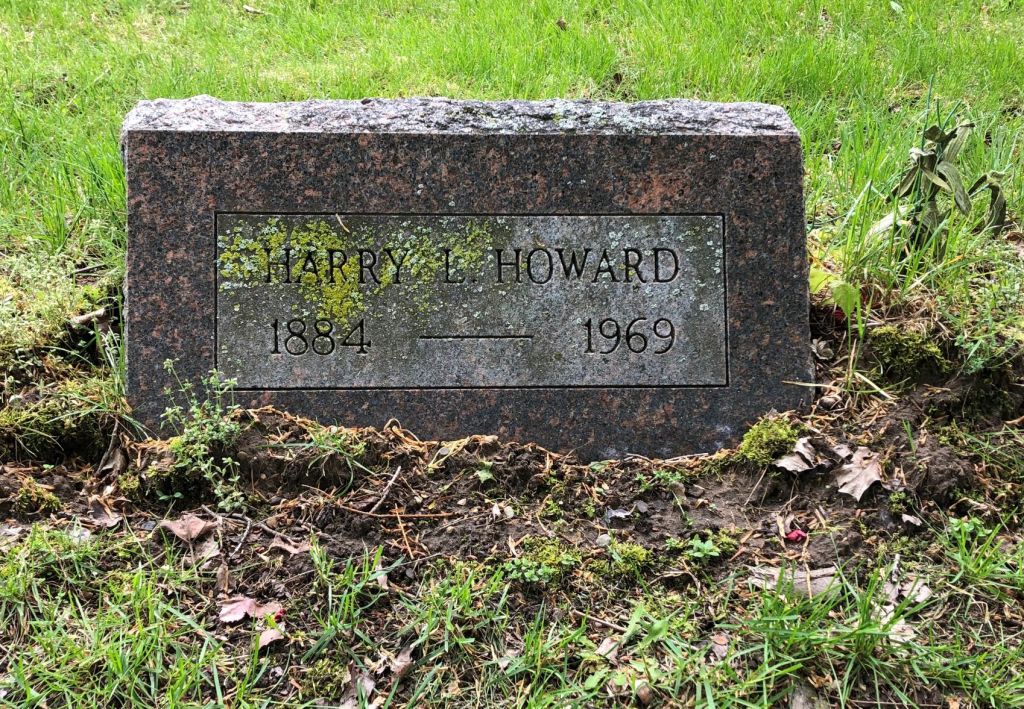
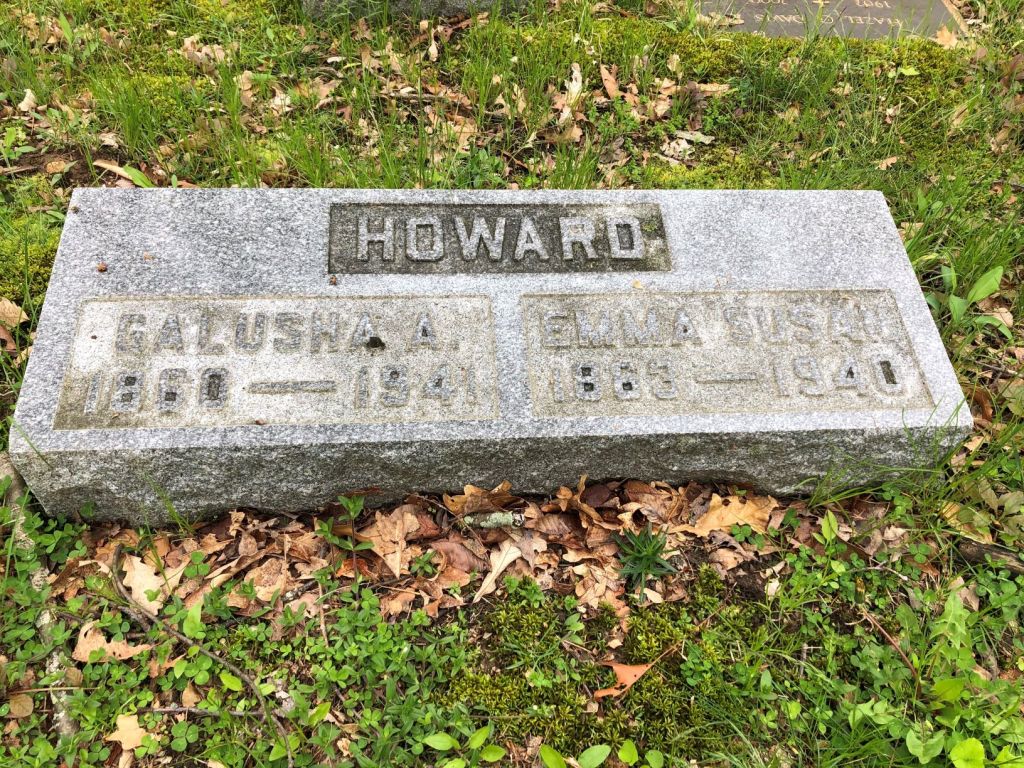
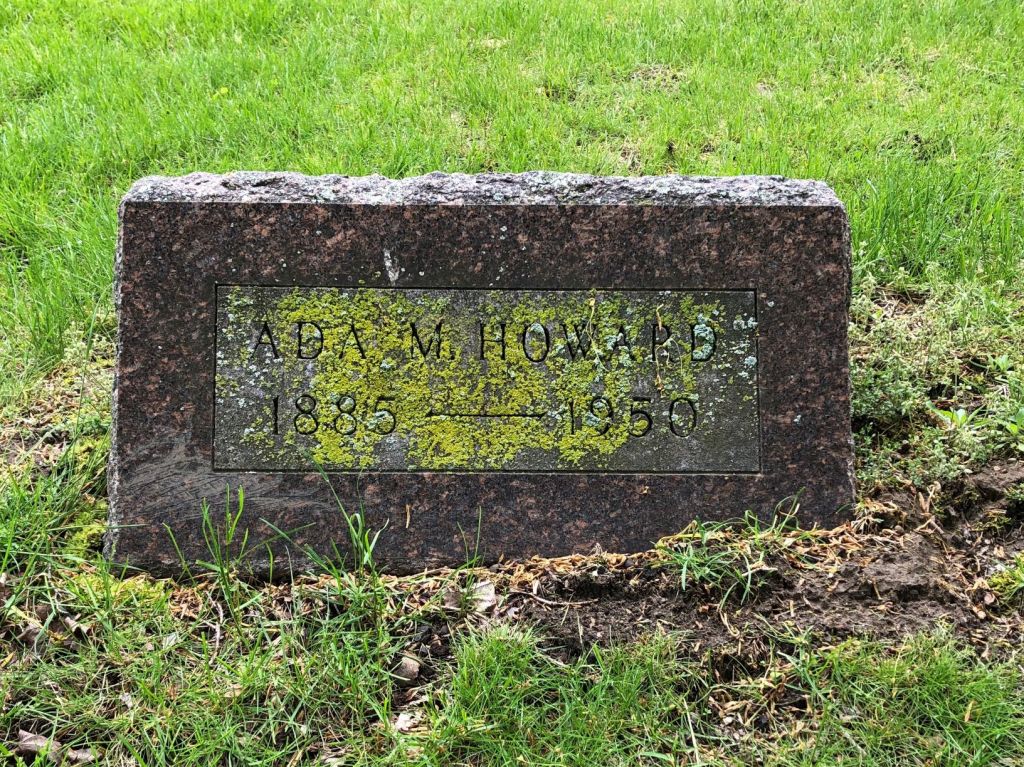
In 1940, Galusha’s wife Emma died in Ypsilanti, Michigan.  Nine months later Galusha passed away as well.  Harry’s wife Ada died in 1950 and Harry died in 1969.  All are buried in Highland Cemetery, Ypsilanti, Michigan.

I learned much about Galusha and his family during a couple trips to Ann Arbor to visit my daughter.  I perused City Directories, maps, land records, and death records there.  Once I determined Galusha, Emma, Harry, and Ada were all buried in nearby Ypsilanti, I visited their graves.  As I stood in the cemetery, I wondered if anyone remembered them now. Or were they nearly forgotten.

Marker for Galusha A. Howard and Emma Susan Trim Howard, Highland Cemetery, Ypsilanti, Michigan.
Marker for Ada Muriel Anderson Howard, Highland Cemetery, Ypsilanti, Michigan.
Marker for Harry Luce Howard, Highland Cemetery, Ypsilanti, Michigan.

The Ypsilanti Historical Society and Highland Cemetery Association provided me with copies of Harry Howard’s obituary, which indicates he was survived by four cousins.  Thus far I have determined that three of the cousins were related to him through his mother’s family.  I am still researching the fourth cousin, Mrs. Ruth Allen of Bay City, Michigan, who is listed as Ruth (Howard) Allen, the informant of death, in the cemetery interment records.


[i] Alpena Argus, March 5, 1872 edition.

[ii] A newspaper article which is part of a compilation of articles housed in the Alpena County George N. Fletcher Library indicates Galusha played “Left” for the team.

[iii] The October 31, 1883 edition of the Alpena Argus reported that Charles H. Luce had left Alpena the day before by the steamer Mackinac, heading for St. Clair “intending to be present at the marriage of G.A. Howard and Miss Trim tonight.”

[iv] It appears that Galusha and Emma named their son Harry after Charles H. Luce.  Charles Luce and his wife Sarah (who I believe was Emma’s niece) named one of their children Howard V. Luce.

[v] Alpena Argus, March 29, 1893 edition.

[vi] It appears much of Emma’s family lived in Ypsilanti.

Strong woman

My great grandmother, Etta Agnes Howard, was born on May 13, 1885, the fourth child of George Francis Howard and Sarah Flewelling Howard.  I have not been able to find a birth record for Etta Agnes, so I can’t say with certainty where she was born.[i] 

When Agnes (her preferred name) was six months old, her mother filed for divorce from her father.[ii]  It appears her mother remarried shortly after the divorce was finalized, to a man named Charles A. Hawley.[iii]  Over the next 15 years, from the time Agnes was two years old until she was 17, Sarah and Charles had eight children together.  Thus Agnes was raised with eight half siblings, in addition to her three full brothers.

The Hawley family resided in Cumming Township, Ogemaw County, Michigan, and Agnes is enumerated with them in the 1900 U.S. Census.[iv] On February 24, 1904, Agnes married Andrew Marshall Walt in Rose City, Michigan. Although her age is given as 20 years old on the marriage certificate, Agnes was 18; Andrew was 35.  On December 29, 1904, their first child was born, Lewis Bruce Walt, my grandfather.

A second son, Howard Clinton Walt, was born to the couple on May 18, 1907 and a third son, Archie Burt Walt, arrived on December 24, 1908.  The 1910 U.S. Census shows that Andrew and Agnes were living with their family in Rose Township, Ogemaw County, Michigan.  Andrew’s occupation was “Laborer” and he owned a farm, which was mortgaged.  On August 30, 1912, Agnes gave birth to a daughter, Frances May Walt.

On May 22, 1913, just nine months after Frances May was born, Agnes’ husband Andrew died.  The cause of death listed on his death certificate was “Tuberculosis of bowels.” A short 25 days later, Frances May – not yet 10 months old – died as well.[v] 

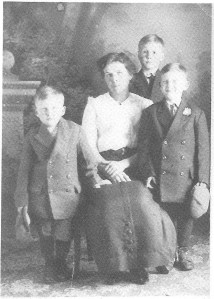
Etta Agnes Howard Walt and sons, (L-R) Archie Burt Walt, Lewis Bruce Walt, and Howard Clinton Walt.

Andrew had deeded Agnes the 40 acres of land he owned in Rose Township five days before he died.  In March 1914, she sold the property for $600.00.[vi] 

From 1914 to 1918, I am not sure where Agnes lived or what she did.  However, there is a brief paragraph in the school news section of the February 17, 1916 edition of the Rose City Review that states “Howard Walt, a second grader, and Bert Walt, a kindergartener, have left for their new home in Flint,” suggesting that she may have moved the family to Flint for a period of time.[vii]

On June 2, 1918, Agnes married Fred Waterman in West Branch, Ogemaw County, Michigan.  She was 33 years old; he was 58. They were both widowers. In the 1920 and 1930 U.S. censuses, Agnes and Fred are enumerated in Cumming Township, Ogemaw County, Michigan.  In 1920 Agnes’ brother Clint Howard and his family appear to have lived right next to her.  In 1930, both her brother Frank and her brother Clint, as well as her mother, are enumerated on the same page of the census as she is.

Fred Waterman died in 1939.  In the 1940 U.S. Census, Agnes is found residing on Donald Street in Flint, Michigan, working as a housekeeper for a couple.[viii]

At some point, Agnes returned to Cumming Township in Ogemaw County and lived on Schmitt Road for a time.  One of her grandchildren remembers her later living in a house in Rose City and vividly recalls the day she died, July 15, 1951.  Her death was reported on the front page of the July 26, 1951 edition of the Ogemaw County Herald under the headline “Etta A. Waterman Dies Suddenly at Rose City Home – Cerebral Hemorrhage Results in Fatality On Sunday, July 15.”

This brief sketch of Etta Agnes Howard Walt Waterman’s life by itself doesn’t really show that she was a “strong woman.” Without a doubt she had trials and heartbreak and probably endured economic insecurity as well.  We tend to label people who go through these experiences as “strong” but I’m not sure I agree with that conclusion.

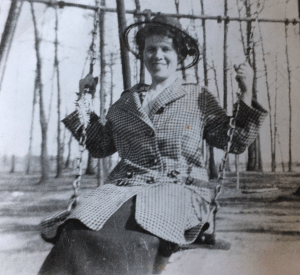
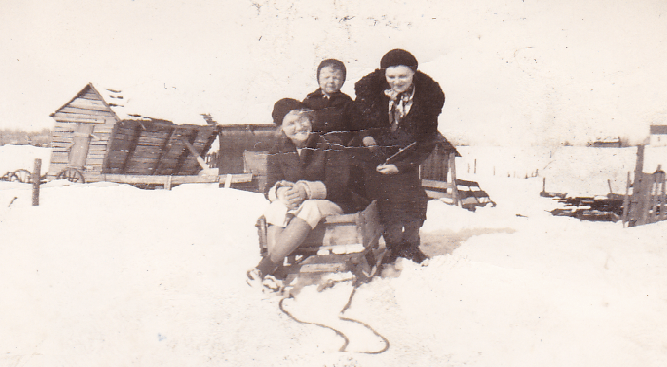
However, I am convinced that Agnes was a strong woman.  And the proof of it is in the photographs below, which show her love and enjoyment of life.   

Agnes smiling broadly while on a swing.

Etta Agnes Howard Walt Waterman

 Agnes sledding with her daughter-in-law and grandson. 

Agnes Waterman, Gilbert Walt, Sarah Walt

Agnes enjoying a summer outing with her grandsons.

Gilbert Walt, Agnes Waterman, Clinton Walt

Agnes wasn’t a strong woman because she endured loss and hardship.  She was a strong woman because – as the pictures clearly show – she didn’t allow those experiences to prevent her from enjoying happiness and joy in her life.  


[i] A handwritten note my grandparents had indicated she was born in Montmorency County, Michigan, which is what her social security record also states.  Her death certificate says she was born in Port Huron, St. Clair County, Michigan.  Neither county has a record of her birth.

[ii] Sarah filed for divorce in Port Huron, Michigan.  It was finalized in February 1886 according to court records in St. Clair County.

[iii] I have found no record of their marriage as of yet.

[iv] Her surname is actually listed as Hawley in the census record.

[v] The cause of death on her death certificate was listed as gastro-enteritis.

[vi] The deed noted that the land was encumbered by “a certain mortgage with interest to the amount of  three hundred eighty six dollars, and the taxes for 1913.”

[vii] There is no mention of the oldest son, Lewis, in the article.

[viii] Agnes’ oldest son, Lewis, and his family also lived in Flint at this time.

Disaster

In 1880, my third great uncle Lafayette Howard was living in the Village of Alcona in Alcona County, Michigan, according to the U.S. Census taken that year.  He was 21 years old and, like his older brothers before him, was employed as a telegraph operator.

On August 29 of that year, Lafayette boarded the steamship Marine City, which was headed for points south along Lake Huron.  The Marine City, a sidewheel steamer known as the “Lady of the Lake,” was a full-service passenger ship but also carried freight.  It was one of the ships in the People’s Line, “a profitable shipping line based out of London, England with a Michigan based operating company.”[i]

According to an ad in the August 10, 1880 edition of the Detroit Free Press, the Marine City left Detroit at 8 p.m. every Tuesday, with stops at Port Huron, Sand Beach, Tawas, Oscoda, Harrisville, Alcona, Alpena, Cheboygan, St. Ignace, Mackinac “and intermediate ports.”[ii] Once the ship reached its northernmost location, it turned around and made a return trip to Detroit.

The Marine City was on one such return trip on August 29, 1880 when my great, great, great uncle boarded her.  The ship had left the port in Alpena shortly before noon that day, headed for Alcona.  Upon arrival in Alcona, passengers and a cargo of shingles were loaded and then the ship started out toward Detroit.  Barely fifteen minutes on its way, a fire was discovered in the starboard bunker.  Although the crew tried to put out the flames, they were unsuccessful and soon the fire spread to the cabin. [iii]

Most accounts paint a picture of pandemonium aboard the Marine City.  The fire rapidly engulfed the ship, and passengers did not have much time before they were forced to jump into the water.  Tugboats nearby came to rescue the crew and passengers from the burning ship and rough, cold water.  However, a number of people died in the disaster.

The Alpena Argus reported: “Lafayette Howard, of this city, who could not swim, succeeded in crawling onto a plank, where he remained till picked up. He says he saw four persons go down beneath the waters.”[iv]

Ten days after the Marine City tragedy, Lafayette married Frances Hewlett in Elkhart, Indiana.[v] They resided in Alcona, Michigan, suffered the loss of an infant child there, moved to Detroit, Michigan and eventually settled in Portland, Oregon.   

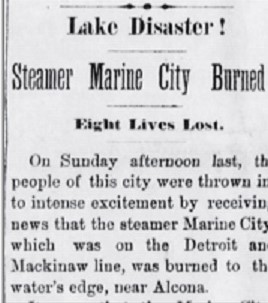
Headline from the September 1, 1880 edition of the Alpena Argus. The death toll was eventually estimated to be 13.

[i] Robert L. Bunting, Into Oblivion, (Oxford, Michigan and Downton, England: Black River Trading Company, LTD., 2007), 15.  This book is an excellent resource for information on life during the mid-1800s in Northern Michigan as well as a good compilation of accounts of the Marine City disaster.

[ii] Detroit Free Press, August 10, 1880, page 5.

[iii] Alpena Argus, September 1, 1880, page 3.

[iv] Ibid. Lafayette was counted in the 1880 Census as a resident of Alcona (albeit a boarder) yet the Argus considered him to be from Alpena.

[v] Frances was listed as a resident of Alcona Village in the U.S. 1880 Census as well, just a few pages before Lafayette.  She was living with her brother-in-law, Frank E. Beard, and sister, Minnie Beard.  F.E. Beard was also one of the surviving passengers aboard the Marine City on August 29, 1880.

Prosperity

My great, great, great uncle, Lucien B. Howard (or L.B. as he was often referred to), has been one of my favorite research subjects.  Even though he’s not a direct ancestor — he is my great, great grandfather’s older brother, the firstborn to Enoch Galusha Howard and Henrietta Walling Howard – I find the details of his life interesting. 

Some time ago I came across a reference to his death in the Sault Ste. Marie, Michigan Evening News which reported “Major Lucien B. Howard, formerly of Menominee, … died recently at Los Angeles, Cal. … He was 57 years of age and was possessed of considerable real estate.”[i]  I have always been curious whether this was an accurate report and whether he enjoyed prosperity in his life.

Lucien was born in New York (probably New York City) around 1847.  He moved with his family in 1855 to Tioga County, Pennsylvania and then six years later, at the age of 14, joined the 45th Infantry Regiment of Pennsylvania Volunteers (which his father organized) as a musician in the Regimental Band.[ii]  He was discharged in 1862 and then reenlisted as a Bugler in 1863 (at age 16) for Company K of Pennsylvania’s 11th Cavalry Regiment.

Lucien was discharged from the service August 15, 1865 and married Angie I. Keeney, a neighbor of the family in Tioga County, on September 7, 1865.[iii]  I found the couple in the 1870 U.S. Census living in Wabasha, Minnesota. Lucien was employed as a bookkeeper.

At some point Lucien and Angie moved to Alpena, Michigan, where his parents and siblings lived.  The Alpena Argus reported in October 1871 that L.B. Howard received the appointment of manager for the telegraph line that was being extended to Alpena from Au Sable.[iv]  For the next ten years, the newspaper contains numerous references to L.B. – his musical ability (which included being a band leader, having a piano tuning service, and winning awards for his cornet playing), his role in organizing and leading the Alpena Guards, his shooting prowess, and his employment with the telegraph company and role in extending the line. 

On November 10, 1880, the Argus reported that L.B. moved to Jackson to work for the telegraph company as a press reporter.  Other references seem to indicate L.B. and Angie subsequently lived in Ludington or perhaps Manistee.   Eventually they settled in Muskegon – city directories indicate he worked for the Chicago & West Michigan Railway Company there – and in the summer of 1889, L.B. moved his parents to Muskegon as well.

Sadly, L. B. experienced the loss of three family members in three consecutive years while in Muskegon.  In 1890 his mother Henrietta passed away.  In 1891 his wife Angie died.  Then Enoch, his father, died the next year.  All three are buried in Plot 1-14-9 of Oakwood Cemetery in Muskegon, although the marker at the site only mentions Enoch.[v]

The 1895 Muskegon City Directory indicates Lucien B. Howard had “removed to Manistee, Mich.” At some point that year, Lucien married Harriet Louise Allen.[vi] 

The 1897 Directory for the city of Menominee, Michigan shows Lucien as a resident there, working as a bookkeeper for the Blodgett & Davis Lumber Company.

In 1898 Lucien appeared on the roll of California’s registered voters, residing in San Bernardino County and voting in Redlands Precinct No. 5.  The voter registration record gives this description of him:  Age – 51; Height – 5’4-1/2”; Complexion – Fair; Eyes – Blue; Hair – Light; Visible Marks and Scars – Scar on little finger left hand; Occupation – Accountant.

At the time of the 1900 U.S. Census, Lucien B. and Louise A. Howard were living on East Citrus Avenue in Redlands, California. Lucien’s occupation is once again listed as bookkeeper and the couple is reported as renting their home.[vii] 

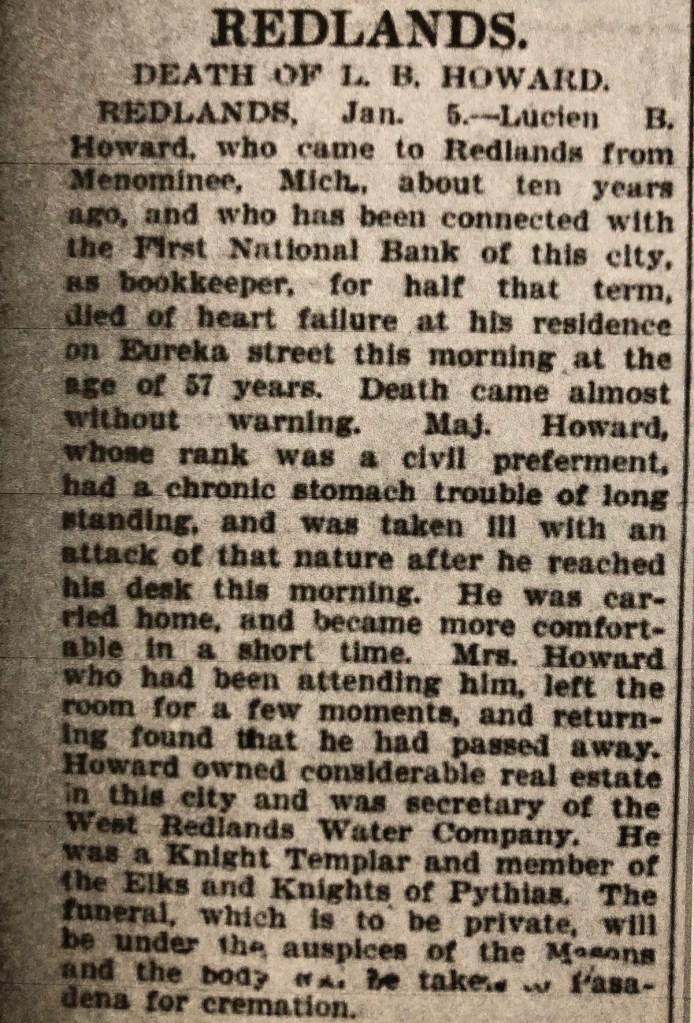
On January 5, 1905, the following death notice appeared in the Los Angeles Times

January 5, 1905 article in Los Angeles Times.

Lucien B. Howard had lived a full life.  But had it been a life of prosperity? The Los Angeles Times article stated he “owned considerable real estate” at the time of his death, which was probably the source of the Sault Ste. Marie Evening News report.  But the San Bernardino County Historical Archives had no record of a probate proceeding filed for him.[viii]  The Archives had two deeds involving L.B., which they kindly emailed to me.  One was an 1897 grant of an easement over a five-acre lot in the “Edmonds Orange Grove Tract” that  L.B. owned in San Bernardino County.[ix]  The other was a deed dated April 29, 1904 from L.B. to Louise for his “undivided one half interest” in the same five-acre lot.  The deed also granted to Louise “eight shares of the capital stock of the West Redlands Water Company, a corporation.”

I found L.B.’s widow Louise in the 1910 and 1930 U.S. censuses.  In 1910 she was living in the household of a female physician in San Diego with several others.  Her occupation was “domestic department.” In 1930 she was still in San Diego, renting a room valued at $15 and employed as a practical nurse. She died in San Diego on December 27, 1948 at the age of 79.

My current theory on Lucien is that he died without any “probatable” assets; that is, he had put all he owned in his wife’s name before he died.  The land and stock that he gave her appears to not have been enough alone to sustain her for the remainder of her life since she was employed as a domestic and a nurse and lived in rented rooms.  Thus it doesn’t seem that Lucien lived such a life of prosperity that he could provide greatly for Louise.

Lucien’s life might not have been one of prosperity from the standpoint of wealth.  But when I look at his life overall – going off to war with his father at the age of 14; being the manager of the first telegraph line in Alpena, Michigan; having much-admired musical ability; moving across the country at age 51 to live and work in California – I believe that he enjoyed a very rich life.


[i] Sault Ste. Marie Evening News, January 27, 1905 edition, page 6.

[ii] According to the Veterans Schedule of the 1890 U.S. Census.

[iii] As reported in the September 25, 1865 edition of the Tioga Agitator.

[iv] Alpena Argus, October 31, 1871 edition, page 3.

[v] The City of Muskegon confirmed this information. As a Civil War veteran, Enoch’s headstone was provided by the U.S. government.

[vi] I have not found a marriage record for the couple, but the 1900 U.S. Census indicates they had been married for five years at the time the census was taken.

[vii] According to the 1900 U.S. Census.

[viii] Both people from the Historical Archives who responded to my email inquiry suggested L.B. and his wife might have lived in Los Angeles, but I have not been able to find an online index to Los Angeles County probate records for this period.

[ix] The easement was “for the purpose of disposing of any and all surpluss (sic) irrigating water” and was granted to James H. Edmonds.

Favorite discovery

My favorite family history discovery tends to be the one I just made.  I’m pretty happy each time I learn something new about one of my ancestors. 

Recently I connected with a third cousin once removed who sent me some information another cousin had sent him on our ancestor Enoch Galusha Howard.  There were copies of old newspaper articles and biographical information on some of Enoch’s descendants.  The article from an 1899 edition of the Alpena Labor Journal about my great, great, great grandfather saying good-bye to his friends in Alpena and moving to Muskegon was one of my favorite discoveries in that packet of information.

Bade Farewell to Alpena

Mr. E.G. Howard, who has been reluctantly preparing to move to Muskegon for some weeks past, on account of Mrs. Howard’s poor health, bade farewell to as many friends as he could see last Monday morning and started on the noon train. … As the old gentleman felt so affectionately attached to the people of this city, all of whom treated him with respect and kindness for the past quarter of a century, he seemed to leave Alpena with a heavy heart. He left, however, with the best wishes of his host of friends. Mr. and Mrs. Howard will be missed in Alpena.

Then this past weekend Newspapers.com offered a “free” weekend to those interested in searching their database of historical newspapers.  I was able to find several more articles from Alpena newspapers which mentioned the Howard family.  One of my favorite discoveries on that database was this story from page 3 of the very first edition of the Alpena Argus, published on June 29, 1871:

PRESENTATION. — Any testimonial tending to show that ones efforts are understood and appreciated, is often far more gratifying to a man than any pecuniary compensation.  The article presented is prized far beyond its mere mercantile value, and as years roll by, fond memories and delightful associations cluster around, adorning it as with a thousand rare and sparkling gems.  Such a testimonial was on Tuesday, of last week, presented by the Alpena Cornet Band, to Mr. E.G. Howard, their skillful and popular leader.  The gift consisted of a fine German Silver Cornet, valued at fifty dollars, of pure tone and beautiful workmanship.  Neatly engraved upon a shield are the words:  “Presented to E.G. Howard, by the Alpena Cornet Band, June 1871.  Manufactured by Geo. F. Stratton & Co., N.Y.” – No more beautiful or appropriate gift could have been selected, and we feel warranted in saying that the recipient, under whose skillful and tireless management the Alpena Cornet Band has won so excellent a reputation, was entirely worthy of the testimonial.

I found numerous mentions of Enoch and his family in the area newspapers – Enoch owned a shoe store in Alpena and advertised regularly and his sons were telegraph operators and musicians like their father.  I started to catalog each reference of the family in the Alpena Argus and had barely made it through the years 1871 and 1872 after working at it for over an hour.  On a whim, I jumped ahead to 1885 (the year of my great grandmother’s birth) and was amazed to find this story in the April 22 edition for that year:

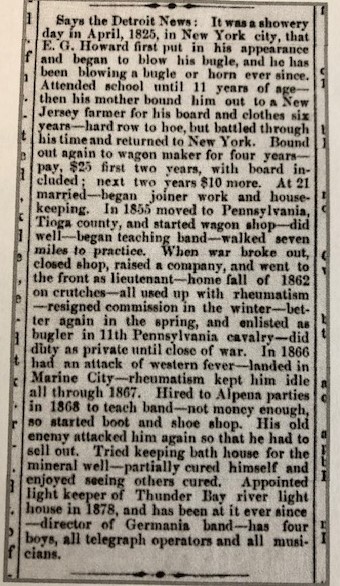
Article in April 22, 1885 edition of the Alpena Argus.

This one article provided me with details of my great, great, great grandfather’s life that I had never found before – he attended school until age 11; his mother bound him out to a New Jersey farmer for six years; he organized a company of volunteer soldiers in Pennsylvania for the Civil War effort; he was hired by people in Alpena to teach band.   

Although the article doesn’t give Enoch’s parents’ names, it does contain a wealth of information for me to sift through which might lead me to other sources.  What connection is there between Enoch and Detroit, Michigan that the Detroit News would print a biography of him in 1885? Might there be a New York City church record of Enoch and Henrietta’s wedding in 1846?  Could the men that Enoch was bound out to have been relatives?

By providing a few more pieces to the puzzle that is my great, great, great grandfather’s life and also by giving me more avenues to research, I can say without a doubt that this article is my new favorite discovery.

Same Name

When I first started researching my great, great, great grandfather, Abel B. Flewelling (also known as Abram B. Flewelling), I looked at all the census records he appeared in that I could find.  I requested a copy of his naturalization record and downloaded a copy of his death certificate.  I looked at plat maps of Fort Gratiot Township, St. Clair County, Michigan, where he lived for over 50 years. And finally, I travelled to Port Huron, Michigan to try to find his grave marker and locate his land. 

From the census records I learned that Abel/Abram was born to Nehemiah and Sarah (Sharp) Flewelling and was probably their oldest child.  In 1851, Abel was 15 years old and lived with his parents and five brothers in Queensbury, York County, New Brunswick, Canada.  By the 1861 Canada Census, Abel was married to his wife Ruth (Elliott) Flewelling and had a four-year-old daughter, Sarah (my great, great grandmother), and two-year-old son, John.  The family resided in Douglas, York County, New Brunswick. 

In 1870, Abel and his growing family were living in Fort Gratiot Township, St. Clair County, Michigan.  He worked as a blacksmith and owned real estate valued at $700.  He and Ruth had six children at home.  By 1880, Abel and Ruth, both 45 years old at this point, had added three more children to their family. Abel’s occupation was now “farmer.” In 1900 Abel and Ruth were living with their youngest surviving son, Joseph, in Fort Gratiot Township.  Abel’s occupation continued to be listed as “farmer.”

Abel filed a Declaration of Intention to become a United States citizen (using the name Abram B. Flewelling) in the Recorder’s Court for the City of Port Huron on April 4, 1870.  However, no further records of naturalization proceedings were found by the Archives of Michigan, which holds such records for St. Clair County.

In 1903, Ruth Flewelling passed away.  It appears that Abel briefly remarried after Ruth’s death, but this second marriage ended in divorce.  Abel died on March 5, 1917 in Fort Gratiot Township.  The stated causes of his death were lobar pneumonia and old age.  Cemetery records reflect that Abel was buried in Lakeside Cemetery in Port Huron, Michigan in the same lot as Ruth, but I could find no marker there which bears his name. 

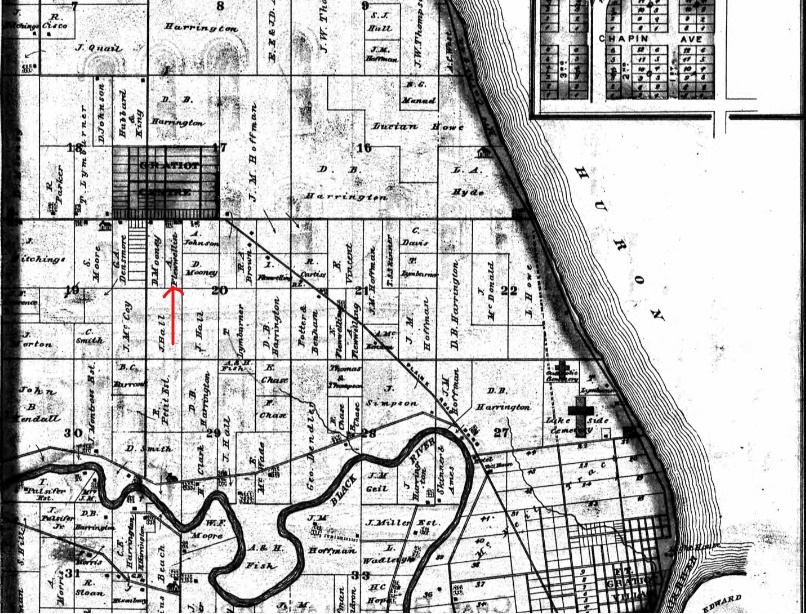
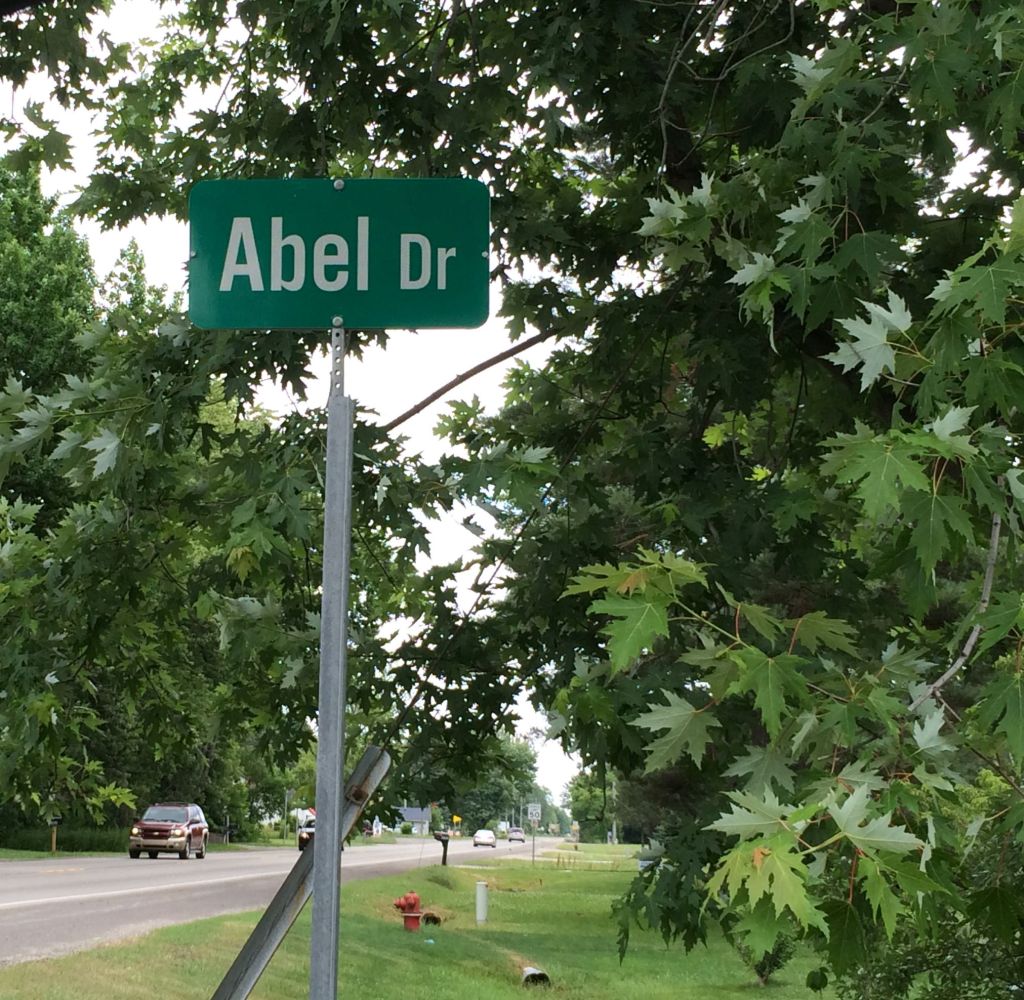
An 1876 atlas of St. Clair County, Michigan contains a plat map of Fort Gratiot Township which shows A. Flewelling as the owner of a tract of land just south of Gratiot Centre. During a visit to the area in 2016, I attempted to locate the tract (using Black River and Lakeside Cemetery shown on the plat map as locators) with the help of Google Maps.  As I turned down the road where I thought the land was, I glanced up at the name of the road on the sign – Abel Dr.  I thought to myself, “Same name.  This must be the right place.”

1876 plat of Fort Gratiot Township, St. Clair County, Michigan.

Later, I inquired of distant cousins whether the road was truly named after our ancestor, Abel Flewelling, and they confirmed it was.

Abel Drive in Fort Gratiot Township, St. Clair County, Michigan. (Photo take in 2016)
Design a site like this with WordPress.com
Get started